A Short Lesson on Customer Experience

My wife and I recently planned a day at a spa located 45 minutes North of our home.
We were celebrating our anniversary, and while I'm not usually a "spa guy", I've been to this venue before, and I liked the combination of the saunas and cold-plunge pools. Plus, most of the spa is outdoors, and our anniversary is in late December, and there's something whimsical about walking around in just your swim shorts while snow covers the ground.
The spa provides everything you need for the day, except for a water bottle and your swimwear. And I forgot to bring both.
Of course, I only realized this when we were 10 minutes away from the spa; returning home for me to pick up my swim trunks would have cost us at least 90 minutes of spa time, so we decided it would make more sense to head to the nearest SportChek sporting goods store (which Google Maps told us was only 15 minutes away) and purchase a new pair.
When you try to purchase swim trunks in December in Canada, in most cases, you have to accept that your selection will be limited.
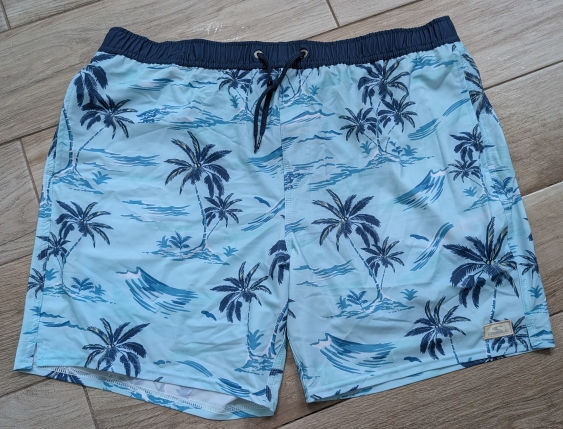
For instance, I normally wouldn't have considered a pair of dual-tone blue shorts with palm trees prominently featured, and I certainly wouldn't have spent $47.97 for them.
But that was the style and price of the shorts the store had in my size, so that's what I reluctantly carried to the store's checkout counter. I considered the cost of the purchase a tax on my forgetfulness.
The friendly salesperson who greeted me when I entered the store and pointed me in the direction of the swimwear when I told her what I needed was at the register. She asked me if I found everything I needed. I nodded, smiled, and then over-shared.
"Well, I found a pair that fit, and that's enough. My wife and I are on our way to a spa near here to celebrate our wedding anniversary, and I forgot my swim trunks... so I'll take what I can get at this point."
"Oh, happy anniversary!" she replied enthusiastically. Then she paused briefly, looked at me, and smiled.
"You know what? I have a VIP discount I can give to you. You don't want to pay that much for a pair of swim trunks, do you?"
"No, no, I do not. Thank you!"
And with that, she applied a 38% "VIP Employee Appreciation Discount", which is exactly what it says on my receipt, saving me $18.27.
The $47.97 plus tax cost of the swim trunks instantly became $34 with taxes and a "round-up" donation to JumpStart.
I understand that some of you reading this will question this cashier's generosity.
"She was flirting with you!"
Okay, fine, none of you are thinking that. And since I was purchasing a pair of 2XL two-toned, palm-tree-themed swim shorts, neither was I.
"She stole from the store!"
No, she didn't. Not at all. She clearly had a legitimate code she could choose to use: if not, "VIP Employee Appreciation Discount" wouldn't have appeared on my receipt. I don't know what guidelines (if any) were provided to the store's staff as to what was (and wasn't) an appropriate use of the VIP code, but I must assume, given the lack of signage promoting this discount, that each employee had a certain amount of discretion. For whatever reason, she chose to use hers for me.
"She should have kept quiet. By volunteering the discount, she cost the store $20!"
Yes, in the short-term, the cashier did cost the store $20 in incremental revenue that day. But the store arguably gained something much more valuable than that in the long term.
A Short Lesson on Customer Experience
Although I found myself in a situation entirely of my own making, having to buy expensive swim trunks I didn't love would have been a negative shopping experience, and that negative experience would have been associated with SportChek even though the brand did nothing wrong.
I felt stupid for forgetting the one thing I needed to bring to enjoy my day at the spa.
I felt irresponsible for having to waste my money on a pair of over-priced shorts I needed to buy to compensate for that forgetfulness.
The cashier seemed to intuitively understand this and decided to do something about it.
It wasn't the discount that made the difference.
It was the cashier's unexpected decision to offer it, making me feel slightly less stupid, much less irresponsible, and much more affinity towards SportChek as a brand.
It’s a powerful reminder that in an era of automated checkouts and rigid algorithms, often the most effective marketing is a well-timed dose of human empathy.
By giving that cashier the agency to "surprise and delight" me, SportChek traded a tiny bit of margin for a massive amount of brand equity.
(And a customer who will take the time and energy to tell the story.)
I’m still not a “spa guy,” and I’m definitely not a “palm trees in December” guy. But thanks to one observant employee who chose to use her discretion, I’m officially a SportChek guy.
And I'd say that's $20 well spent, wouldn't you?