Amazon's Retail Digital Signage Play

Amazon has quietly launched a product with the potential to become a retail game-changer.
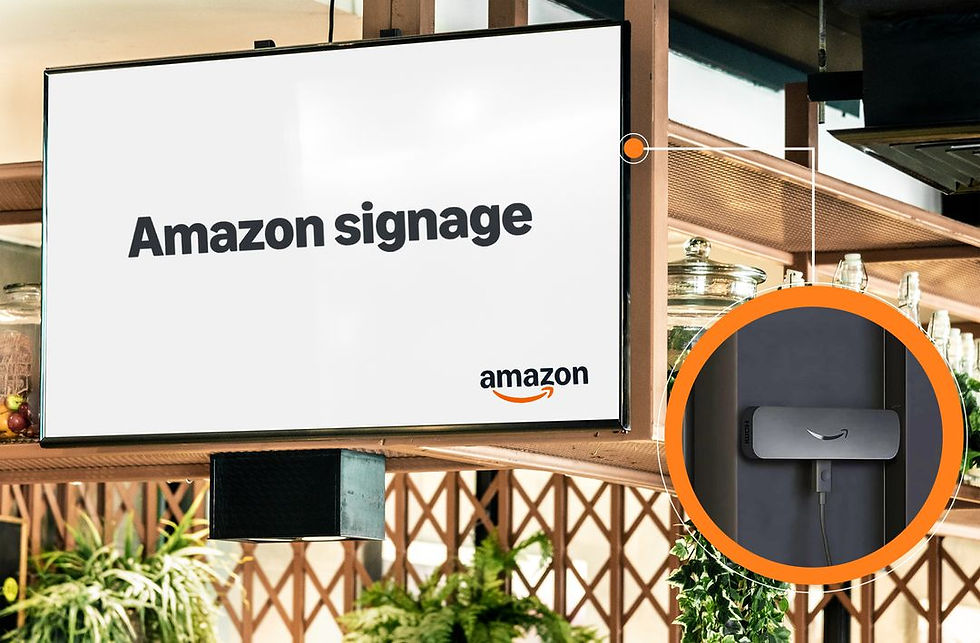
The Amazon Signage Stick promises to instantly transform any HDMI-enabled TV into a dynamic display. It comes pre-leaded with support for 25 leading Content Management Systems (CMS) that allow businesses to "seamlessly upload static images, videos, or interactive content to their displays."
Put simply, smaller businesses can now access the same promotional advantages their larger and better-funded competitors currently enjoy in an easy and affordable way.
The easy part is thanks to the plug-and-play design of the device. If you have an Amazon FireTV Stick connected to your television right now, you'll likely know what you can expect with the Signage Stick. Plug it in, go through some basic set-up... and it just works.

And the affordable part? The Amazon Signage Stick is priced at just 99.99 USD.*
Now let's do some quick math:
You can buy a 50-inch 4K UHD television for under 200 USD.
Add another 99 USD for the Amazon Signage Stick.
Then add 240 USD per year (per screen) for a basic CMS plan.
And what do you get for that 500 USD year-one investment?
Smaller food establishments can suddenly afford digital menu boards, allowing them to quickly and easily adjust food items, menu prices, and bundle offers. Depending on the CMS system chosen, dynamic pricing that optimizes revenue may even be possible.
Conference organizers can now affordably display event schedules throughout their venues, dynamically promoting agendas and speakers and making last-minute adjustments as needed.
Retailers of all shapes and sizes can promote in-store deals, even swapping out one deal for another based on available inventory.
The possibilities are exciting. And almost endless.
Amazon's Retail Digital Signage play -- the Amazon Signage Stick -- could become a retail game-changer.
And if I were working at Amazon today and wanted to ensure that happened?
Here are three things I would do as soon as possible, listed by how easy it would be to implement each recommendation:
1. Partner with a TV manufacturer to make TVs "almost-free" for Signage Stick purchasers
You can't use a Signage Stick without a television. And while televisions are already relatively affordable (as noted above), the capital cost could still prove to be a barrier for retailers who may need more than one TV for their location.
This is a barrier that Amazon can almost entirely eliminate with the power of scale: partner with a television manufacturer to offer promotional exclusivity in exchange for a significant discount on televisions offered to registered business that purchases a Signage Stick.
Customers would receive a better price for the cost of the TVs needed. Amazon would encourage more businesses to become Signage Stick customers. And TV manufacturer would not only get increased brand exposure, but also see a significant volume lift that could take advantage of excess manufacturing capacity and help amortize fixed costs. That's a win-win-win!
2. Enable Creative Design via GenAI
Retailers won't need a Signage Stick if they don't have any digital signs to display. But not every retailer has the time, money, or know-how to create effective digital signage.
The solution here is both obvious and straightforward: Amazon should offer a tool to Signage Stick users that provides them with an easy way to develop the creative they need.
This isn't a novel idea: Amazon already offers Amazon sellers an "Enhance my Listing" tool, which uses Generative AI to help them create more effective product listings.
A combination of standard templates (think "menu templates" for restaurants and "Weekly Featured Buy" templates for clothing retailers) and Generative AI would make it easy for Signage Stick users to develop attractive and effective digital signage with minimal cost and effort. The increase in sales that should result will help demonstrate the utility of the Signage Stick, encouraging expanded usage. Win-win!
3. Allow Signage Stick customers to show Amazon Ads... and share in the resulting revenue.
If the launch of the Signage Stick is successful, the result will be a lot more screens in retail locations. And you know what Amazon is already very skilled at doing?
That's right: monetizing screens.
Imagine you're a retailer that has just purchased a Signage Stick for your retail clothing location. While you're setting up you're new device, you're asked, "would you like to participate in the Amazon Retail Revenue Share Program?"
Intrigued, you click "Yes", and are taken to a website where you are asked to answer the following questions:
Who are the customers that come in to your store? (Providing some basic information about the store's audience will help Amazon deliver more relevant advertising.)
How much of your sign real-estate is allowed for ads? (The website informs you that the more real estate you allocate, the higher percentage of ad revenue you earn.)
What ads are NOT allowed to be displayed on your screens? (This would allow you to specify entire categories -- i.e. "clothing retailers" -- or specific companies and brands -- i.e. Gap, Old Navy, Walmart -- that you consider competitive.)
Amazon uses this information to know what ads to show (and what ads NOT to show), and then allocates a percentage of the ad revenue to the retailer.
Is this recommendation easier to write than execute? Absolutely. But I would argue the idea of leveraging increased retail screens for hyper-targeted advertising (and incentivizing retailers to give up a portion of their screens in exchange for an incremental revenue source) is interesting enough for Amazon to seriously explore.
If I was response for the success of the Amazon Signage Stick, those are three recommendations I'd start exploring immediately to help ensure the device fulfills its tremendous potential.
And one final recommendation I'd make to the Amazon team?
Change the name of the product.
Aside from the alliteration, it's terrible... and it sounds far too much like "Signage Schtick" for something that could prove so useful for so many retailers.
* I'm using USD because the Signage Stick has launched in the US; international expansion is planned for 2026.